
Rabbit Care Resource Center
Science-based guidance for rabbit, guinea pig, chinchilla, and other small pet parents.
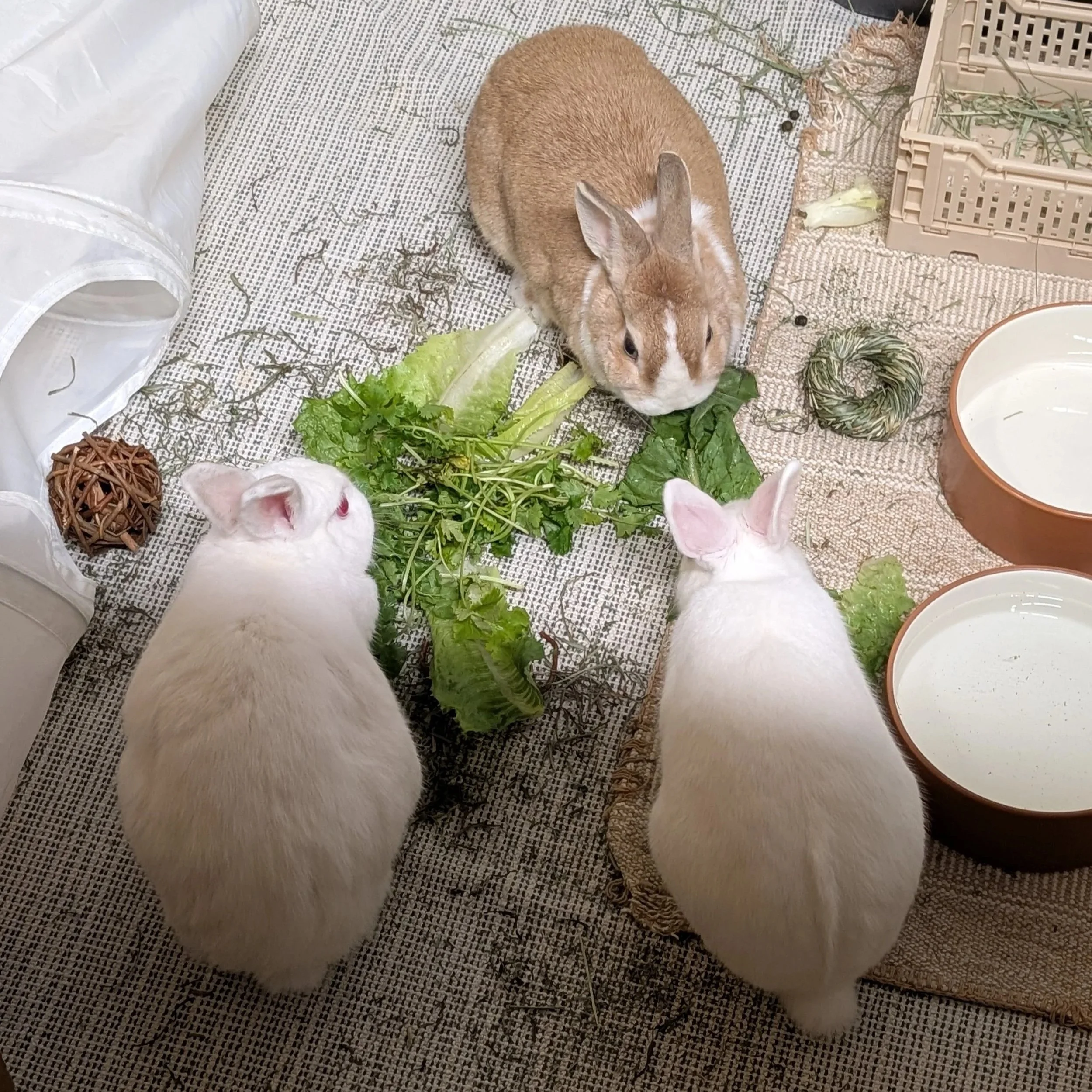
Welcome to our comprehensive collection of educational resources covering everything from rabbit bonding techniques to emergency care, housing setups to enrichment ideas. These articles represent years of hands-on experience caring for our own rescue rabbits (Marshmallow, Macaron, and Chocolatte), volunteering with LA and Orange County shelters + rescues, and applying behavioral research principles to real-world rabbit care challenges.
Whether you're a first-time rabbit parent or an experienced small pet parent, you'll find practical, research-backed advice to help you provide the best possible care for your pets.
Browse our resource library below - organized chronologically from most recent to oldest, covering topics including bonding, health, nutrition, housing, enrichment, veterinary care, and more.
Looking for something specific? Use your browser's search function (Ctrl+F or Cmd+F) to find articles by keyword or browse by category:
Rabbit Health · Rabbit Care + Life · Adoption + Rescue · BCB Archive
the science of rabbit bonding
Bonding is the deliberate, gradual process of building a positive association between two or more rabbits who do not yet have one. It is a behavioral process - governed by the same principles that govern all learning in all species - and when it fails, it almost always fails because those principles were not respected.

santa ana winds + rabbit dehydration
Southern California rabbit parents are familiar with heat. But Santa Ana wind events are a different animal entirely - and they carry a dehydration risk that standard heat safety advice doesn’t fully address.

how to teach your rabbit to ring a bell
Rabbits are not passive pets. They have preferences, opinions, and a surprisingly sophisticated ability to communicate - if you give them the tools to do it.
Bell training is one of the most practical things you can teach your rabbit. It can be a fun party trick, but it is a fantastic communication system. A rabbit who has learned to ring a bell to get your attention has agency over their environment in a way that reduces frustration, reduces unwanted behaviors, and genuinely strengthens your bond.
Marshmallow, our alpha bunny, has bells placed by the fridge, her litterbox, and her castle. She rings whichever one is closest to where she needs us to be. She did not teach herself this - we taught her (and then she perfected it to her own advantage).

how to give your rabbit medication at home
Giving medication to a rabbit at home can feel intimidating, especially the first time. Rabbits are small, fast, and not particularly enthusiastic about being medicated. But with the right technique and a calm approach, most rabbits tolerate medication administration well - and some even come to accept it as part of their routine.
This guide covers the four most common types of medication administration your exotic vet may ask you to do at home: oral medication, ear drops via dropper, ear medication via syringe, and eye drops.

keeping your rabbit safe in the heat
Rabbits are prey animals built for temperate climates. They are not built for Southern Californian heat waves. When temperatures rise, even briefly, a rabbit's body has very few tools to compensate. They cannot pant effectively. They cannot sweat. Their primary heat dissipation mechanism is their ears, and in extreme heat, this will not be enough.
Heat stroke in rabbits can progress from subtle signs to life-threatening distress in under an hour. Knowing what to watch for - and acting before you see the worst signs - is the difference between a rabbit who recovers and one who does not.

what to consider before surrendering your rabbit
We are not here to guilt you.
Surrendering a rabbit is not always the wrong decision. Sometimes it is the most responsible one. What we care about is that when it happens, it happens thoughtfully - with your rabbit's welfare as the priority, not an afterthought.
Before you make that call, we ask you to sit with these questions honestly.

rabbit respiratory health: what sneezing actually means
One of our boarding guests came to us sneezing; not constantly, just occasionally. His vet was not alarmed - his family had been told it was likely a hay allergy and he seemed otherwise well.
Over the following ten months, what turned out to be aspiration pneumonia progressed into a severe abscess. The abscess displaced his lungs upward and his stomach downward. Despite aggressive treatment, he passed on.
We share this not to frighten you, but because we wish someone had told his family sooner: sneezing in rabbits is never just sneezing.

what to do when a rescue won't take their animals back
You said yes because you wanted to help. You opened your home, bought supplies, learned care routines, and showed up - often for animals who came to you frightened, malnourished, or medically fragile. You did everything right.
But now the rescue won't respond when your contract is up or you need to return your fosters for any changes in circumstances.
BCB has seen this firsthand. We know what it looks like when a rescue weaponizes the foster agreement against the very people who volunteered to help them.
Do not use this article as a guide to which rescues to avoid - this is not what it’s written for. It’s meant to help you advocate for the animals in your care best.

what to expect before your rabbit's stay - health requirements + why they matter
If you have ever boarded a dog or cat, you already know the drill:
Current rabies vaccine
Bordetella
DHPP
Flea and tick prevention
A wellness exam within the past year
No reputable dog or cat boarding facility will accept a guest without these - and no one questions it. It is simply understood that a shared environment requires shared standards.
Bun Chia Burrow holds the same standards for rabbits, guinea pigs, chinchillas, hamsters, and rats. Yet, because your small pets are still widely perceived as low-maintenance animals that don't require "real" veterinary care, we are occasionally asked to explain ourselves.
So we hope this helps.